
Begin a Sandy Springs Residents Directory Search
Match the clue to the index first. Fulton County property search accepts an owner name, a situs address, or a parcel number. It also takes advanced criteria. The GSCCCA Real Estate Index reaches recorded parties and land references. Georgia My Voter Page is different. It verifies your own registration rather than browsing a street. Fulton and statewide court indexes can tie a name to a filed case. Central Library directories can place an earlier household at an address.
No roll covers everyone. Property data centers on owners, and tax mail can go elsewhere. A permit may name an applicant or contractor without proving residence. Voter rolls skip the unregistered and shield some addresses. A directory volume is a dated snapshot. Treat each find as one piece of a Sandy Springs residents directory trail.
- Check Fulton QPublic by owner name or street address and note the parcel ID.
- Use Georgia My Voter Page only for the voter's own authenticated details.
- Search GSCCCA by party, county, date, instrument type, or book and page.
- Use Atlanta suburban and Haines directories for older occupants.
- Send a focused written request to the right custodian when an item is not online.
Where Sandy Springs Residents Directory Records Live
Sandy Springs is in Fulton County, not the seat. City hall routes city-created material. Fulton offices keep the deeds, assessments, trial-court files, probate, marriage records, elections, and many vital-record channels. For a street-by-street method, the Sandy Springs street directory shows how the records connect. Start there for current names and addresses.
Fulton County Recorder / Register of Deeds
136 Pryor Street SW, Ground Floor
Atlanta, GA 30303
404-613-5313
Fulton County Board of Assessors
235 Peachtree Street NE, Suite 1400
Atlanta, GA 30303
404-612-6440
Fulton County Registration and Elections
5600 Campbellton Fairburn Road
Fairburn, GA 30213
404-612-7020
Sandy Springs Residents Directory Starts in Fulton
The city incorporated on December 1, 2005. That single date explains a lot. No long municipal archive exists, so a search cannot stay inside City Hall. Fulton County ran local services before incorporation and still keeps the core land, court, probate, election, and vital records. City holdings shine only for recent permits, code matters, meetings, police reports, and municipal cases.
Custodian dates and portal dates differ. Sandy Springs moved active and existing permits into OpenGov in July 2024, but that software change did not start the record. Search OpenGov for recent work. Ask the city about city-era files not shown there, then move older permit questions to Fulton, deeds, plats, tax files, and directories. The record is older than the tool.
Read a Sandy Springs Parcel Without Assuming Residence
Fulton QPublic turns a name into a parcel or a street into an owner of record. Results can include the parcel ID, situs address, owner mailing address, legal description, value history, sale references, and map links. Those fields are pivots, not a census. A mailing address elsewhere may just mean tax mail goes to an owner's other home. A matching situs does not list everyone inside.
The parcel ID is the durable key. Carry it into the map viewer. Copy the land-lot and subdivision clues. Then chase the deed reference to the recorded transfer. The record holds up best when owner name, legal description, parcel outline, and recorded deed all agree.
What the Sandy Springs Deed Index Adds
The GSCCCA Real Estate Index holds deed-docket transactions for every Georgia county from at least January 1, 1999. Historical additions keep growing. Searches by Name, Property, and County Book and Page can be narrowed to Fulton County, a date, a party role, or an instrument type. Results name parties, book, page, instrument, and property.
A free Limited-Use account shows index summaries but not document images. Single-Use access costs $5 for four consecutive hours, Regular access is $14.95 per month, and printed pages cost $0.50. Confirm current charges before purchase.
The image below comes from the official GSCCCA search entry.
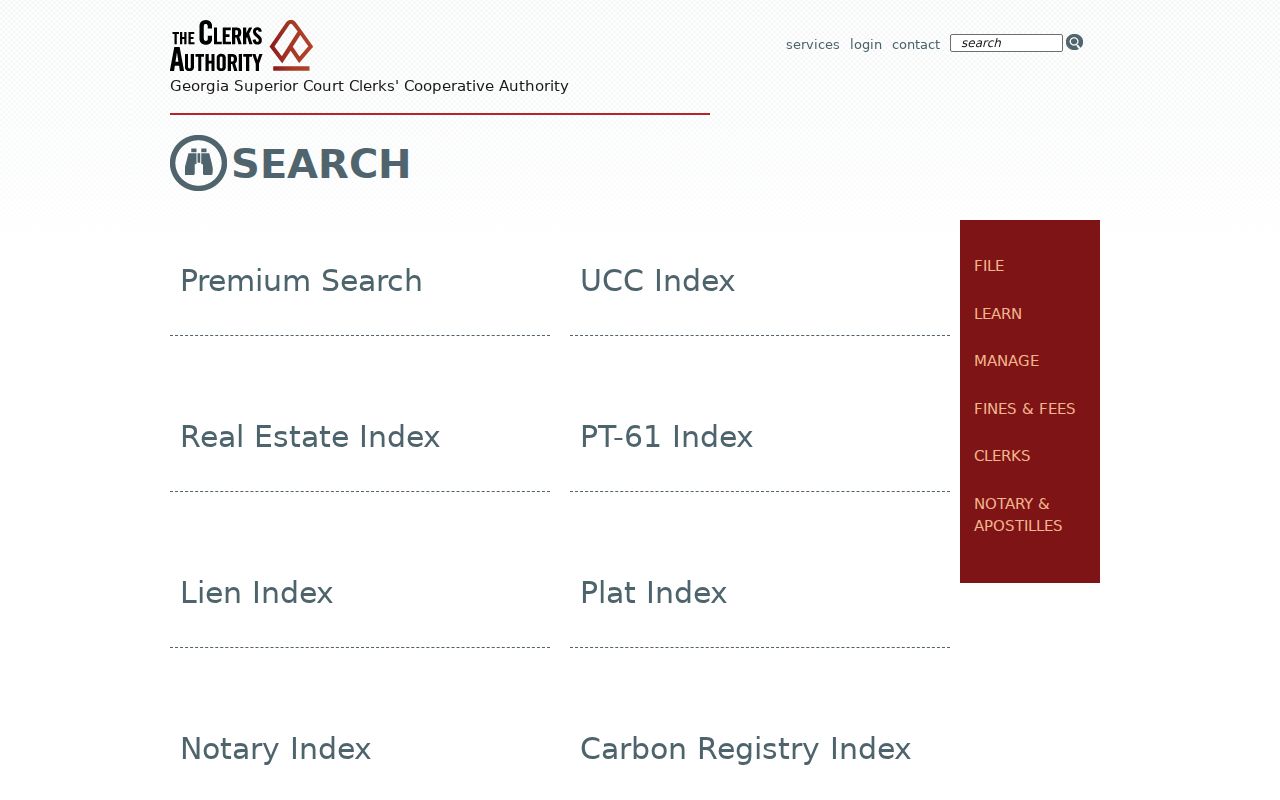
The search modes shown there separate a named party search from a book-and-page verification.
A Sandy Springs Address May Still Say Atlanta
Mailing geography is the main local trap. Sandy Springs addresses have long carried Atlanta or another last line. In March 2026, USPS approved Sandy Springs as the default preferred last line for municipal addresses in 30319, 30327, 30328, 30338, 30339, 30342, and 30350. ZIP code 30092 was left out. The change created no new ZIP codes and moved no city limits.
Search both variants in older indexes. Use USPS to test mail format, city GIS to test municipal limits, the assessor for tax situs, and a deed's legal description for title continuity. Each system answers a different question.
Current Sandy Springs Residents Directory Sources
Modern directory-like sources are purpose-built lists. The owner roll, the authenticated voter tool, the deed index, and the public agency roster each cover a defined group, and none is a complete resident list.
| Source | Who It Lists | Keeper | Access |
|---|---|---|---|
| Fulton property roll | Owners of record | Board of Assessors | Free portal |
| My Voter Page | The authenticated voter | Georgia Secretary of State | Free self-lookup |
| Real Estate Index | Recorded-instrument parties | GSCCCA and Fulton clerk | Summary search; images may cost |
| City public pages | Elected and public-facing officials | City of Sandy Springs | Free online |
| Association contacts | Public leaders, not households | Local associations | Only when posted |
Use the Sandy Springs resident lookup when one name must be checked across several sources. Match, never merge. Two look-alike rows are not one person.
What Sandy Springs Voter Tools Actually Confirm
The Georgia My Voter Page works on a self-lookup basis. You supply a name, county, and date of birth. In return it confirms registration status, districts, polling place, absentee status, a sample ballot, and participation history. Ballot choices stay private. There is no open browse-by-street directory here. So a Sandy Springs voter lookup verifies one record rather than mapping a block.
The fuller voter file is a separate request product. Election authorities define its fields and lawful-use limits. Voters enrolled in VoteSafe can have address details withheld. A missing public address never proves a missing registration.
The Georgia My Voter Page screenshot shows the self-lookup entry point.
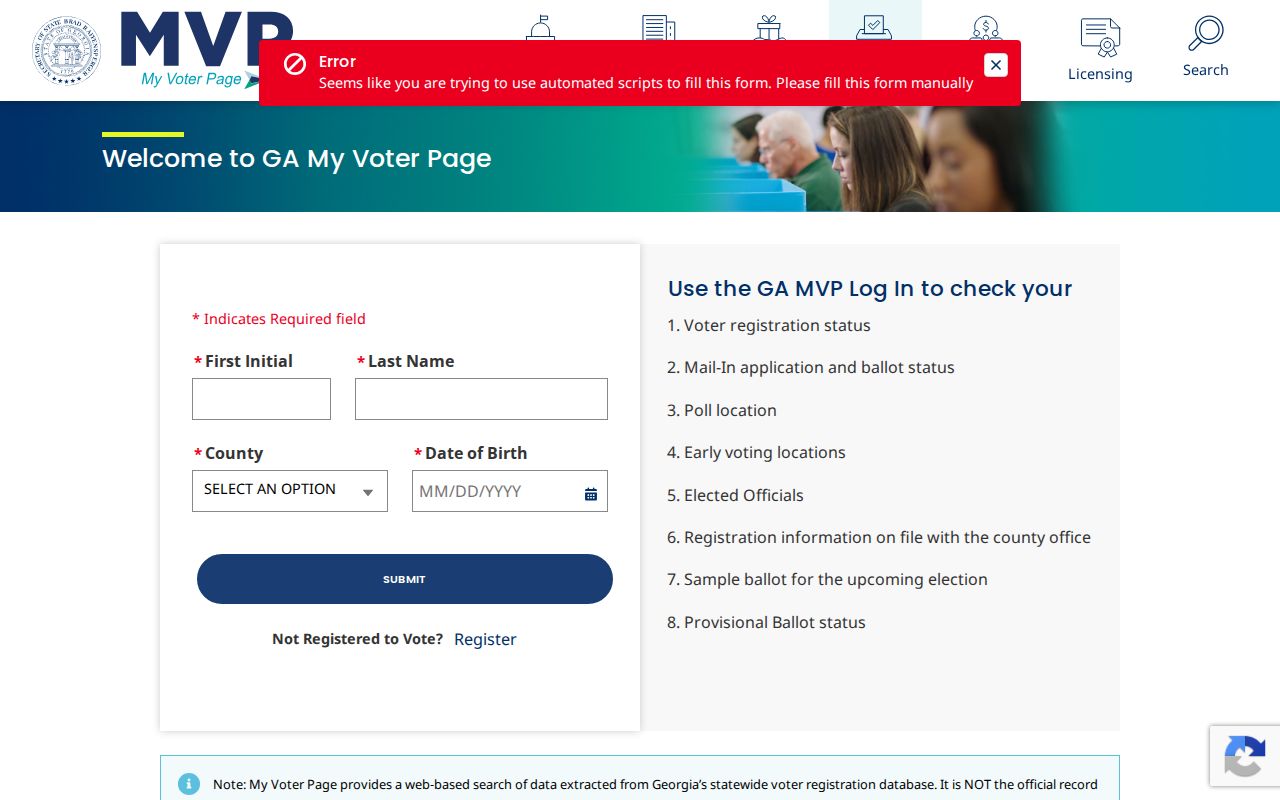
Its identity fields explain the design: the tool verifies a voter's own record, not a neighborhood listing.
Sandy Springs City Records After Incorporation
The city prefers that searchers use a dedicated channel first. OpenGov publishes permits, development plans, code-enforcement status, and related project events where available. The Open Data Portal holds maps and datasets. Meeting portals carry agendas, minutes, presentations, and video. Police incident and crash reports run through their own channel. They sit apart from the general records office workflow.
Anything not already posted goes through JustFOIA. A request needs a department or request type, contact details, and a specific description. Under the Georgia Open Records Act, the custodian ordinarily responds within three business days. Search, retrieval, and redaction time past the first 15 minutes may be billed at the lowest-paid qualified employee's rate. Paper copies cost $0.10 per page citywide. Separate listed prices apply for plats, video, accident reports, and media.
The city records guide explains the routing choices shown below.
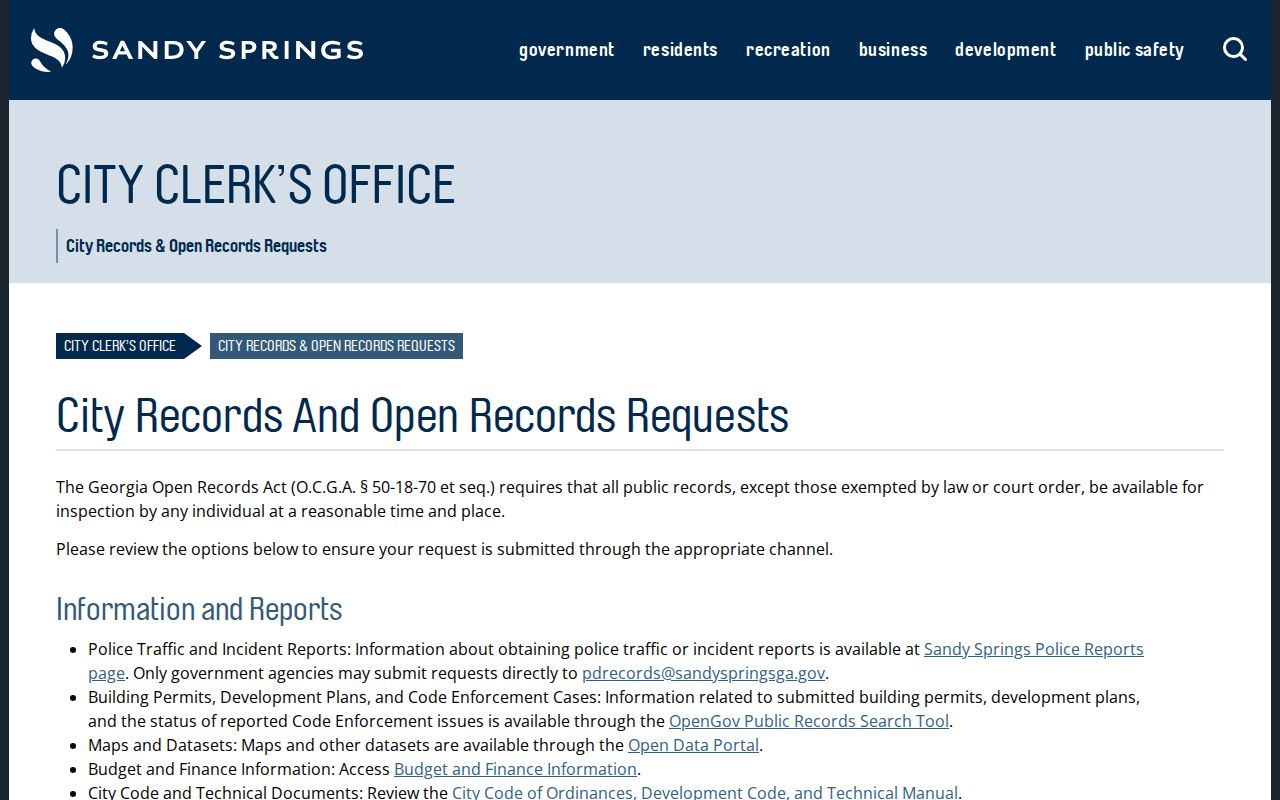
Starting with the subject-specific portal can spare you a broad request and leave a cleaner trail.
Courts and Custody Records in a Sandy Springs Search
Sandy Springs Municipal Court takes city ordinance and misdemeanor traffic matters. It moved with police headquarters to 620 Morgan Falls Road in April 2025. Fulton Superior, State, Magistrate, Probate, and Juvenile courts each serve different case types. For online starting points, Fulton Clerk Smart Search and re:SearchGA offer differing document coverage.
A docket name is a lead, nothing more. It is not proof of identity or wrongdoing. Before relying on a hit, check the court. Also confirm the case number, filing date, party role, and any address detail. The Georgia Department of Corrections offender tool and the GBI registry are narrow statutory sources. Fulton Sheriff inmate information is a narrow custody source. None is a general Sandy Springs residents directory.
The image is linked from the Fulton Sheriff's official inmate information page.
Verify with the named agency and record number instead of trusting a copied listing.
Sandy Springs Vital Records Use a Different Standard
Vital records for Sandy Springs events follow their own rules. Birth and death certificates may run through the Fulton County Board of Health. They may also run through the Georgia State Office of Vital Records. Fulton Probate Court issues marriage licenses. Divorce decrees stay with Superior Court. Getting a certified copy is a different task from finding an index fact.
Georgia law and health rules limit certified birth copies to eligible relatives and representatives. Death records have a qualified-copy path. The public can obtain a plain-paper copy with the Social Security number redacted. Georgia publishes no fixed year after which birth records open. Assume no age cutoff.
Old Milton County Can Recover a Missing Heir
Older Sandy Springs-area records cross county lines. Milton County existed from 1857 until it merged into Fulton on January 1, 1932. A Fulton-only probate or deed search can miss an earlier family entirely. FamilySearch's combined will run covers Fulton from 1854 and Milton from 1865. Its cross-county indexing reaches from 1833 through 1948.
For an estate or family-history question, work backward from a known Fulton parcel or person. Then repeat the surname, land, probate, and marriage search under Milton. This is a geography problem. The older record was not lost.
Historical Sandy Springs Residents Directory Shelves
Fulton County Library System keeps its city directory shelves at Central Library. The Sandy Springs branch is not the place for them. Central Special Collections holds Atlanta directories from 1859 through 1991. Suburban directories run from 1953 through 1986, and Haines criss-cross volumes span 1946 through the 2016–2017 run. The Sandy Springs branch handles current library service instead. Digitized Atlanta directories and library genealogy databases add other routes. Heritage Sandy Springs and the Atlanta History Center round out a historical residents directory search.
A printed entry can establish a lot. It may show a named person, spouse, occupation, or household at an address in that edition. A Haines volume flips the question. It moves from address to occupant instead of name to street. Compare adjacent years before concluding that two entries name the same household. Deeds, tax plats, obituaries, and the released 1950 census help too. The full collection method sits on the Sandy Springs city directory page.
The Central Library city directories collection page displays the holdings.
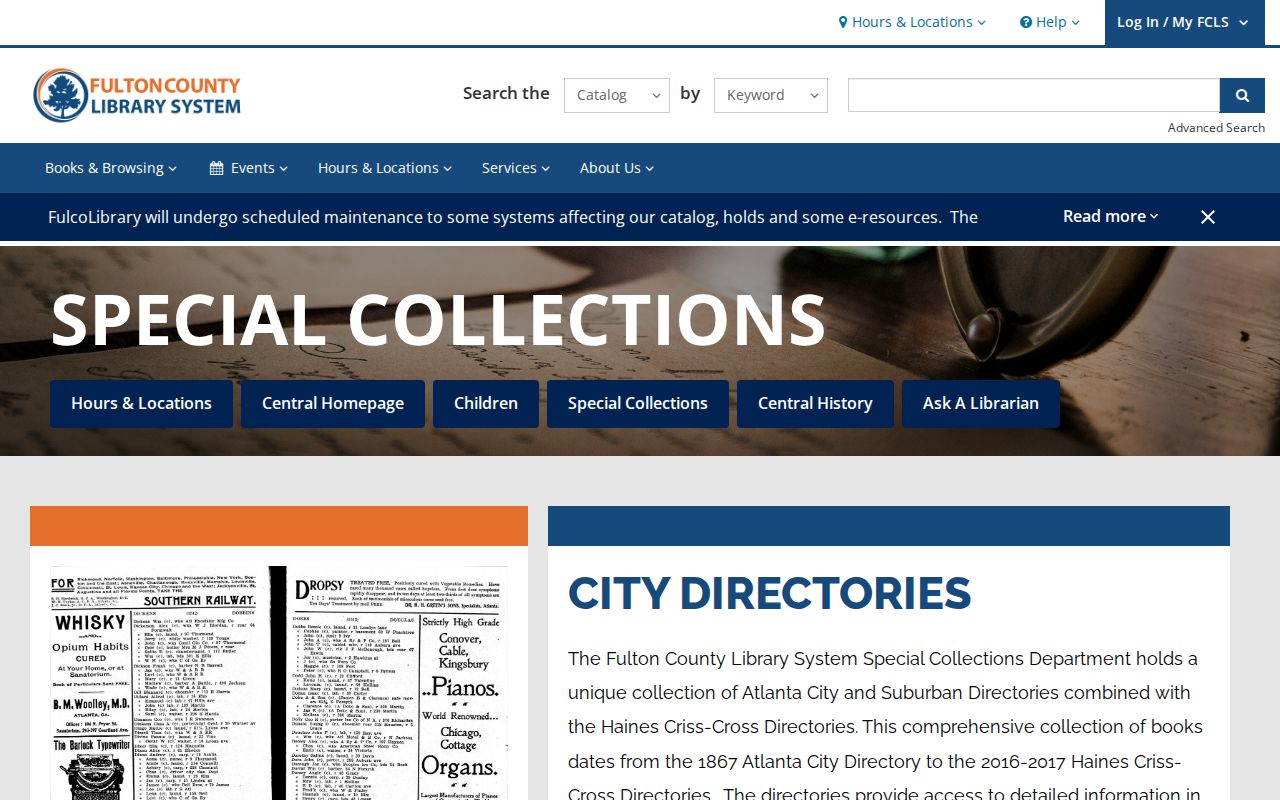
Metro coverage matters here. Old Sandy Springs entries may be filed under Atlanta suburban geography rather than the modern city name.
Verify One Sandy Springs Name Across Roles
A careful name search separates each role from the pile. It refuses to force every hit into one person. The assessor names an owner of record. A deed index surfaces grantors, grantees, lenders, borrowers, and other indexed parties. Court dockets label plaintiffs, defendants, petitioners, respondents, and attorneys. The Georgia corporations search can reveal a registered agent or officer. Professional verification shows license holders and facilities.
Record the exact spelling for every result. Add the middle initial, date range, record number, role, and address. A match is plausible only when several independent details agree. Even then the custodian's current record settles the question. Common surnames, reused family names, and stale mailing addresses make name-only matches weak.
| Known clue | Best first source | Useful next key |
|---|---|---|
| Owner name | Fulton QPublic | Parcel ID and situs |
| Recorded land party | GSCCCA index | Book, page, instrument |
| Case party | Fulton or re:SearchGA | Court and case number |
| Business affiliation | Georgia SOS | Control number and role |
Sandy Springs Public Requests Work Best When Narrow
The Georgia Open Records Act, O.C.G.A. §§ 50-18-70 through 50-18-77, opens a route to records that already exist. It does not require an office to build a new residents directory. A narrow request works best. Name the custodian, describe the record type, give a useful date range, and add an address or case number when known. Ask for electronic delivery if that format exists. A written request creates the clearest timeline.
Custodians may redact protected data and release the rest. They can also send a cost estimate when search, review, retrieval, or copying incurs fees. Ask to inspect first when the goal is a small set of pages. City Hall sits at 1 Galambos Way, with civic offices open 8 a.m. to 5 p.m. weekdays; permitting hours run 7:30 a.m. to 4 p.m. The main city number is 770-730-5600.
Use directory information only for a lawful personal or civic purpose. Do not use it to stalk, harass, threaten, or harm anyone, and respect address-confidentiality programs.
The Sandy Springs Heritage Collection Fills a Young-City Gap
Sandy Springs has a short paper trail as an incorporated city. Its community story runs much deeper. The Georgia Archives backed that story in 2023 with a $4,680 grant. That money funds a public online inventory and portal for the Sandy Springs Heritage Collection. Heritage Sandy Springs adds its own layers. The group interprets Indigenous use of the land, rural farming days, suburban growth, and the push toward incorporation. It does so through photographs, graphics, objects, and oral histories.
None of this stands in for a deed, an assessment, a certificate, or a court file. What it offers is context. It surfaces names and leads that point back to those official records. Search by local organizations, neighborhood terms, street names, and the city's six planning focus areas as well as family names. For older families, repeat the work under Atlanta, Fulton County, and old Milton County labels.